If you asked me to name the two things that shaped the internet generation I grew up in, I wouldn't say smartphones or social media. I'd say:
- Digital pirates.
- Open source.
One broke the rules. The other rewrote them. They look like opposites, but I've come to think they're two answers to the same question:
What happens when everyone, not just people who can afford it, gets access?
Let me be clear before anyone sends me an angry email: I'm not telling you to pirate anything. Creators deserve to be paid. I've worked on an indie film that's crowdfunding right now, so I feel this personally. This post is about what piracy revealed, and why I think it ended up pushing the world toward something better.
Part 1: The pirates
Where a lot of us actually learned
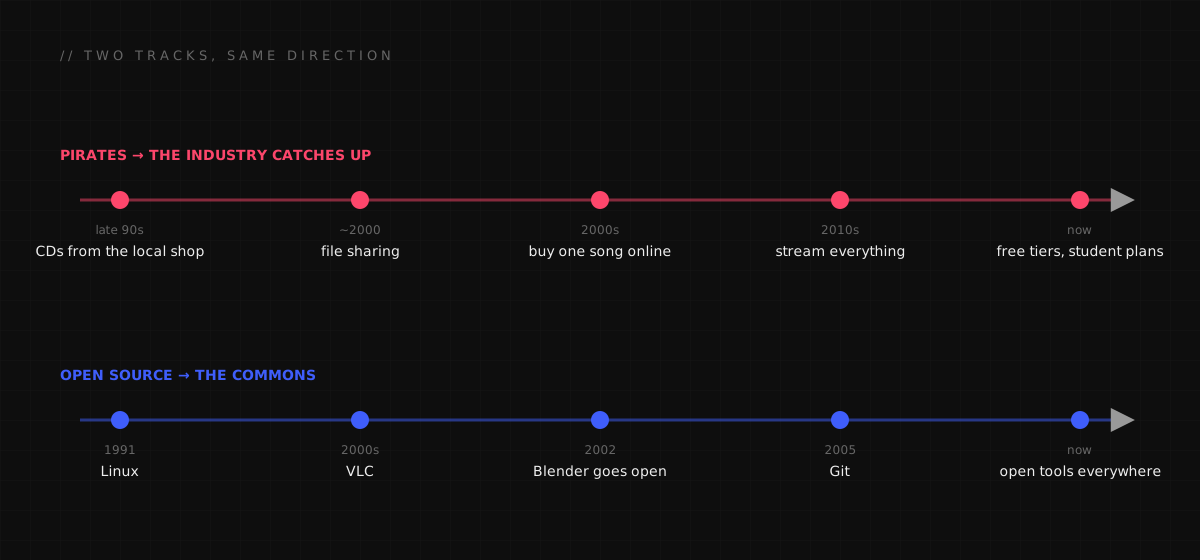
Talk to designers, video editors and engineers from small-town India, or almost anywhere outside the rich world, and you'll hear a version of the same story. Their first copy of a professional design tool, video editor or 3D package didn't come from an official store. It came on a CD from a local shop, or a link from a friend of a friend.
Officially, those tools cost more than a family's monthly income. Unofficially, they were everywhere. And a whole generation of creative and technical people learned their craft on them, because that was the only door that was open.
That's an uncomfortable truth for the software industry: a lot of today's paying professionals got their start on software they didn't pay for. The pirated copy was the free trial that the companies refused to offer.
Pirates proved the demand
Pirates also did something the industry was too slow to do: they showed what people actually wanted.
When file-sharing exploded around 2000, it wasn't because everyone was a criminal. It was because people wanted any song, instantly, on any device, and nobody legal was offering that. A few years later, the legal options that won looked a lot like the pirate experience. First you could buy single tracks online. Then came streaming: everything, instantly, for a monthly fee. Spotify's founders have openly talked about building it as a better alternative to piracy.
Gabe Newell, who runs Valve, put it well back in 2011: piracy is mostly a service problem, not a pricing problem. Give people something better than what pirates offer and most of them will happily pay.
The honest downside
None of this makes piracy fine. It hurts small creators the most, because big companies can absorb losses and an indie filmmaker or a solo app developer often can't. It also gets used as an excuse long after the excuse stops being valid. When a tool has a free tier, a student plan or a fair regional price, "I can't afford it" doesn't really hold anymore.
So my view is this: piracy was a symptom. It showed exactly where access was broken. The right response was never just to sue people. It was to fix access. Where the industry did that, piracy shrank on its own.
Part 2: Open source
The pirates' better-behaved sibling
If piracy was people taking access, open source is people giving it, legally, on purpose, at a scale nobody would have believed 30 years ago.
Think about how much of the world runs on things people gave away:
- Linux started in 1991 as a student's hobby project. Today it runs most of the world's servers, the Android phone in your pocket, and probably your Wi-Fi router.
- VLC, started by students in France, plays every video file you throw at it, for free, with no ads.
- Blender went open source in 2002 after its community raised money to buy it out from its parent company. Now it's a serious 3D tool used in professional productions.
- Git, which almost every software team on earth uses, was written in about two weeks in 2005 and given away.
And that's just the famous stuff. Every web app you use is built on thousands of open-source libraries, many maintained by one or two people in their spare time.
Why open source is even better than piracy
Piracy gives you access to a copy. Open source gives you access to the knowledge.
With a pirated tool, you can use it. With an open-source tool, you can read exactly how it works, change it, fix it, learn from it, and build your own thing on top of it. That's not just access to software. It's access to the craft.
I learned web development by reading other people's code: view source, GitHub repos, open-source design systems. Nobody charged me for that education. Some stranger had decided their work should help whoever came next.
The honest downside, again
Open source isn't perfect either.
- Maintainers burn out. Huge companies make billions on top of libraries maintained by unpaid volunteers. That's not sustainable, and it's not fair.
- "Open" gets watered down. Some projects call themselves open but lock the useful bits behind a paid tier, or change their licence once they're popular.
- Free isn't free to run. Someone pays for the servers, the bandwidth and the hours.
If you use open source at work, which you almost certainly do, the least you can do is sponsor a maintainer, contribute a fix, or just write a thank-you issue.
What they have in common
Here's why I put these two together.
Both pirates and open-source people looked at a world where tools, knowledge and culture were locked behind price tags and borders and said: this should reach everyone. Pirates did it by breaking the lock. Open source did it by never putting a lock on in the first place.
The world ended up somewhere in between: streaming instead of CDs, free tiers and student plans instead of ₹50,000 licences, and a huge commons of free software underneath everything. I'm convinced both forces pushed us there.
Why this matters to me
This is the reason I put so much of my own work out as open source: tools for running coding agents, a daily brief app, a menu bar utility, a free Git course for beginners. I'm not doing it to be a saint. I'm paying back a debt.
Somewhere, some kid with a cheap laptop and a slow connection is trying to learn what I'm doing. I'd like the door to be open when they get there. Not because they broke the lock, but because there wasn't one.