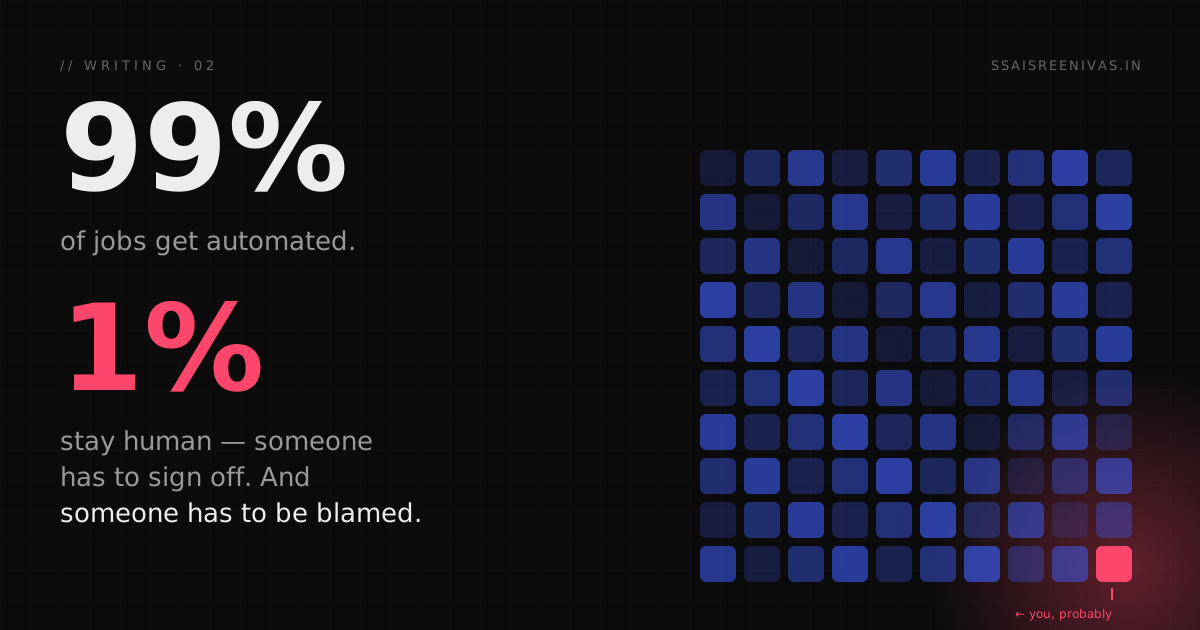
Every few weeks there's a new headline: AI will replace X% of jobs by 20XX. The number goes up, the year comes closer, and everyone argues about whether it's 30% or 80%.
My hot take is half joke, half not:
Only 99% of jobs will be affected. The last 1% stays human, because corporate needs someone to blame.
I'm being cheeky, but the more I sit with it, the more I think it's the most honest description of where this is going.
The work isn't the job
Here's the thing people miss in the "will AI take my job" debate. Most jobs aren't just the work. They're the work plus responsibility for the work.
A radiologist doesn't just read a scan. They put their name on the report. A chartered accountant doesn't just add up numbers. They sign the audit. A senior engineer doesn't just write code. They approve the deploy that might take down payments at 2 a.m.
AI is getting very good at the first half: reading the scan, adding the numbers, writing the code. It's not getting any better at the second half, because the second half isn't a skill. It's a role in society. You can't send a model to court. You can't fire it in a way that makes the customer feel better. You can't put it in front of a board and have it say "this was my call, and I was wrong."
What "affected" really means
When I say 99% of jobs will be affected, I don't mean 99% of people will be unemployed. I mean almost every job will have its work part shrink, sometimes a lot. What's left gets concentrated into fewer people, and it's mostly three things:
- Deciding what should be done.
- Approving what was done.
- Answering for it when it goes wrong.
The 1% is a feature, not a bug
Before this sounds too cynical, the "someone to blame" role is actually important. Accountability is what makes systems trustworthy.
When a bridge collapses, there's an engineer whose stamp is on the drawings. That's not cruelty. That stamp is why engineers check their drawings so carefully. Remove the person who can be blamed and you remove the reason anyone is careful.
So when a company says "a human is always in the loop", I read it two ways:
- The good way: a person with judgment checks the output, catches the weird stuff, and owns the decision.
- The bad way: a person is kept around so there's someone to fire when the model messes up. A human crumple zone.
Both will exist. Which one you get depends on the company.
The rubber-stamp trap
The bad version scares me, so let me make it concrete.
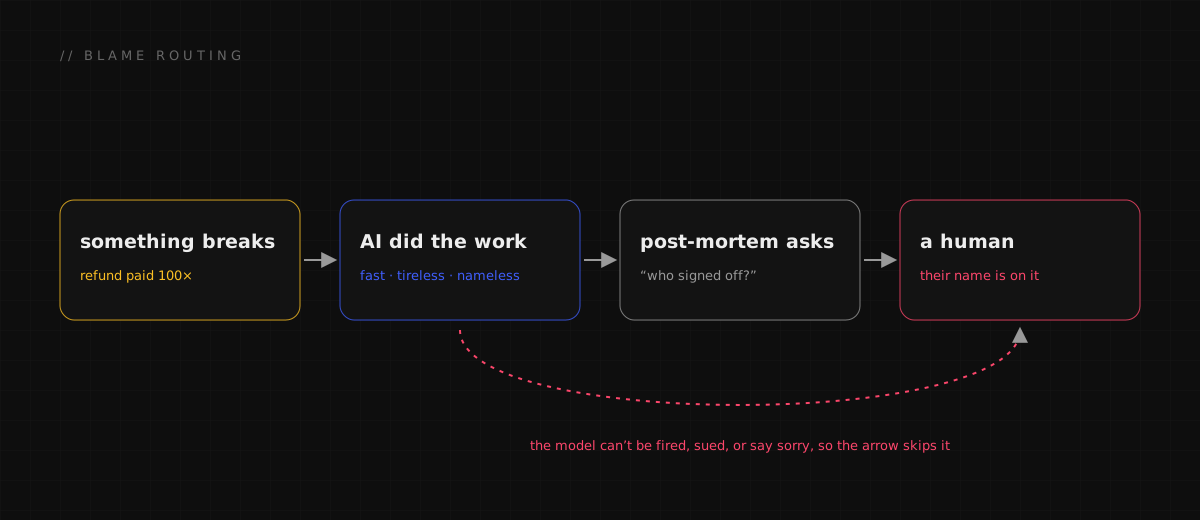
Imagine you're the one human approving 400 AI-generated refunds a day. In theory, you review each one. In practice, after the first week, they're 99.5% correct and you're clicking "Approve" in under two seconds each. Then one day, a bug approves a refund 100 times. The post-mortem asks: "Who approved this?" The answer is you.
You weren't really reviewing. You couldn't have been, not at that speed. But your name is on it.
That's the 1% job done badly: all of the blame, none of the actual control. If you end up in a "human in the loop" role, the most important thing you can do is make sure the loop is real:
- Insist on a volume you can actually review.
- Insist on tooling that shows you the risky cases, not all cases.
- Write down when you think the process is unsafe. If you're going to be the name on it, make sure your objections are on it too.
How to be in the 1% on purpose
If the surviving jobs are mostly about judgment and accountability, then the skills worth building are pretty clear. None of them are about typing faster.
Taste. Knowing what good looks like before you see it. AI can produce a hundred options. Someone has to know which one is right, and why.
Domain depth. You can't approve what you don't understand. The person who signs off on the financial model needs to actually understand finance.
Owning outcomes, not tasks. "I wrote the code" is becoming worthless. "I made checkout work and I'm on call for it" is becoming the whole job.
Saying no. The most valuable sentence in an AI-heavy company will be "We're not shipping this, here's why." It's also the hardest one to say.
Being someone people trust to be blamed. This sounds strange, but it's real. Organisations trust people whose names they're comfortable putting on things. That trust is built slowly, by being right, by being honest when you're wrong, and by not hiding behind "the AI did it."
"The AI did it" won't work
Speaking of which: I think we're about to see a lot of people try "the AI did it" as an excuse, and I think it'll fail almost every time. Customers, courts and bosses don't care which tool you used. They care whose decision it was. Nobody accepted "the spreadsheet did it" in 2005, and they won't accept "the model did it" in 2030.
If anything, using AI raises the bar. You had a tireless colleague that could check everything. Why didn't you have it check?
So, should you be worried?
A little. The work part of most jobs is shrinking, and anyone who says otherwise is selling something. But the human part — deciding, approving, answering for it — isn't going anywhere. If anything it's becoming the whole job.
So if you want to be safe, don't try to out-type the machine. Be the person whose judgment the company actually needs, and make sure that when your name goes on something, you really did check it.
Be the 1%. Just make sure you're the good kind.