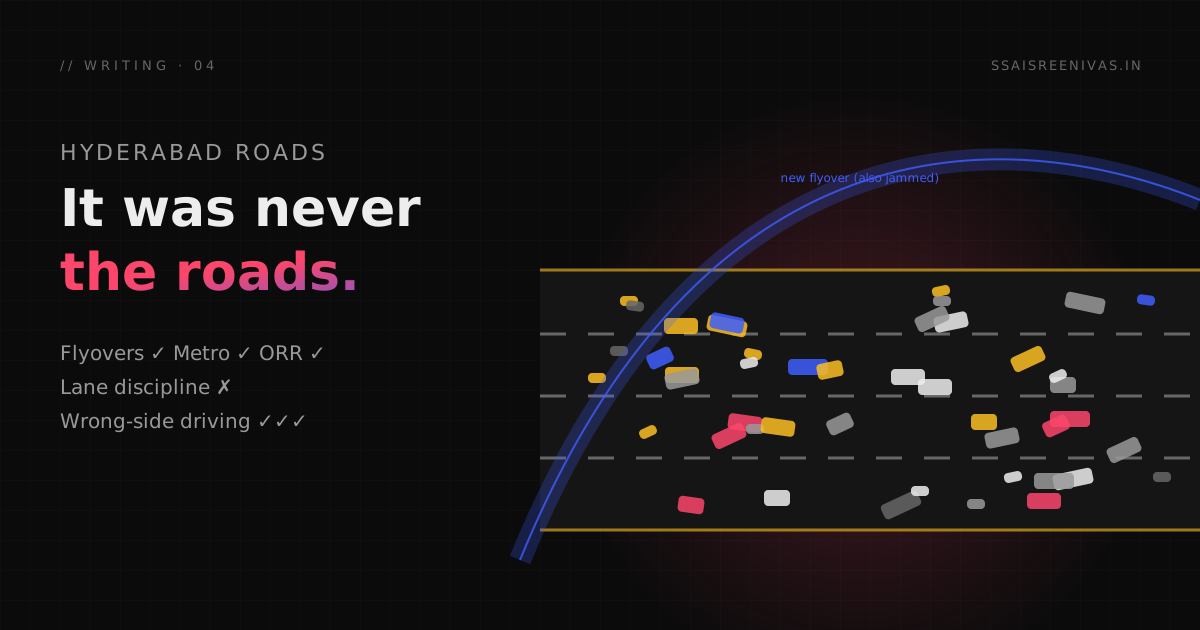
If you've lived in Hyderabad for more than a few years, you've watched the city build an incredible amount of road.
Flyovers at junctions that used to be a 20-minute wait. The Outer Ring Road wrapping the whole city. The Metro, running above the busiest roads. Underpasses, link roads, the Durgam Cheruvu cable bridge that's now on every Instagram reel about the city. On paper, Hyderabad's road infrastructure today is something people in many cities would envy.
And yet, at 6:30 p.m. on a weekday, you're still sitting there. Same jam, new flyover.
I've spent a lot of hours in that traffic, and somewhere around my hundredth evening stuck near a junction that had just been fixed, I came to an uncomfortable conclusion:
Hyderabad's traffic was never really an infrastructure problem. It's a behaviour problem, a design problem and a demand problem, and concrete can't fix any of those.
Exhibit A: watch any junction for five minutes
Pick any busy junction and just watch. In five minutes you'll probably see:
- Someone driving on the wrong side of the road because the U-turn is 400 m away.
- An auto stopping right at the mouth of the junction to pick up a passenger.
- Two-wheelers filling every gap, including the free-left lane, so nobody can actually turn left.
- A car parked in the first lane "just for two minutes".
- Three lanes of painted road being used as five lanes of actual traffic.
- A bus that can't reach the bus stop because the stop is blocked by vehicles waiting at it.
None of these is caused by a missing road. Every one of them takes away capacity from a road that already exists. A six-lane road where one lane is parked on, one lane is blocked by stopping autos, and the rest are cut across diagonally works like a two-lane road.
Exhibit B: the flyover loop
Here's the pattern I've seen at junction after junction:
- A junction is jammed.
- A flyover gets built (after a year or two of worse jams during construction).
- For a few months, traffic flows beautifully. Everyone's happy.
- People notice the route is faster now. More people take it. Some who used to take the bus start driving.
- The jam is back, just moved to the end of the flyover.
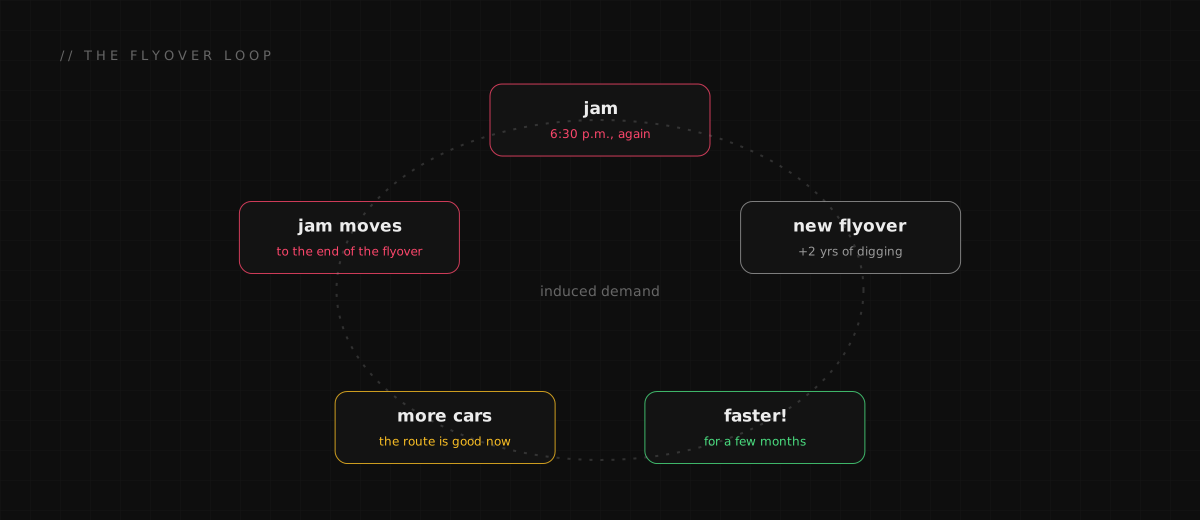
This has a name: induced demand. Make driving easier and you get more driving. It's been observed in cities around the world for decades. Adding road capacity to fix congestion is a bit like loosening your belt to fix overeating. It feels great for a week.
That's not an argument against building roads. The ORR, for example, really did change how goods and long-distance traffic move around the city. It's an argument that building roads alone can't win, because the thing we're fighting isn't a shortage of road. It's what happens on it.
Exhibit C: the design is fighting us
Some of it isn't the drivers' fault at all. A lot of our road design actively encourages bad behaviour:
- Long U-turn gaps. When the legal U-turn is 800 m away and the wrong-side route is 50 m, you're designing for wrong-side driving.
- Footpaths you can't walk on. Broken, encroached, or randomly a metre high. So people walk on the road, so the road loses a lane.
- No place to stop. Autos and cabs have to pick people up somewhere. If there's no bay, the bay becomes the first lane.
- Last-mile gaps. The Metro is great, until you have to get from the station to your actual office. If that last kilometre is miserable, people just drive the whole way.
Good design makes the right behaviour the easy behaviour. A lot of our design makes the wrong behaviour the easy one, then blames people for doing it.
Exhibit D: everyone is solving their own trip
This is the part that's hardest to say, because it includes me.
Traffic is a classic case where everyone acting sensibly for themselves makes things worse for everyone. Cutting into the next lane saves you five seconds and costs the 40 cars behind you ten seconds each. Stopping at the junction to drop a friend is convenient for you and blocks a whole lane for everyone else.
Each of us is optimising our own trip. Nobody is optimising the road. And no flyover can fix lakhs of people each making the locally sensible, globally terrible choice.
So what would actually help?
I'm not a transport planner, so take these as a frustrated software person's opinions. But the pattern is the same one I see in products: when a system is slow, you don't just add more servers. You fix how it's used.
1. Enforce the boring stuff, consistently. Lane discipline, no stopping at junctions, no parking in the first lane, no wrong-side driving. Not with a big drive for one week, but every day, so it becomes normal. Cameras help, but only if fines actually reach people.
2. Design for how people actually move. Shorter U-turn gaps. Real pickup bays near Metro stations and office gates. Footpaths that are continuous, flat and free of encroachment. Make the right thing easy and most people will do it.
3. Make buses and the Metro the obvious choice. More frequent buses, dedicated bus lanes on the main corridors, and actually-good last-mile links from Metro stations. Every person who switches from a car to a bus frees up road for everyone, including the people still driving.
4. Spread the peak. A lot of our jam is everyone going to the same tech corridor at the same hour. Flexible office hours and hybrid work already showed how much this matters. The roads during lockdown and work-from-home weren't a different city. They were the same roads with fewer cars.
5. Stop measuring success in flyovers. "We built 10 flyovers" is an output. "Average commute time went down" is an outcome. Measure outcomes.
The hopeful part
Here's what gives me hope: none of this needs a miracle. The concrete is already there. Hyderabad has better road bones than most Indian cities. What we need now is the stuff that doesn't make for a ribbon-cutting ceremony: rules, design and habits.
The next time you're stuck under a brand-new flyover, look around before you curse the government for not building enough road. Count the cars on the wrong side, the autos stopped at the junction, and the lane that's become a parking lot. The road is big enough. We just haven't learned to share it yet.